

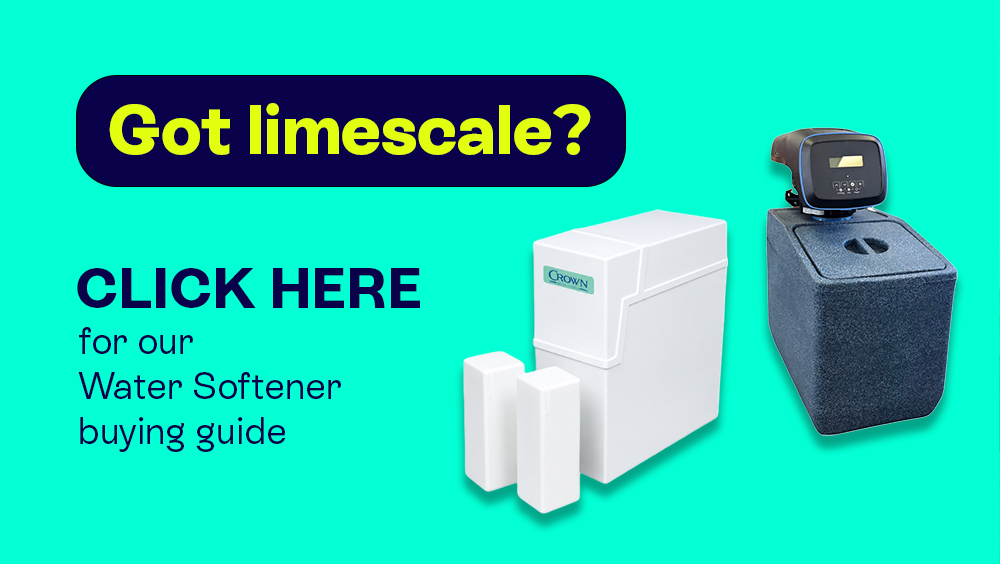
Choosing a water softener can feel confusing at first. There are electric and non-electric models, block salt and tablet salt systems, different sizes, different regeneration times and different installation requirements.
This guide explains the main things to check before buying a water softener, so you can choose the right system for your home, your water usage and your installation space.
Why buy a water softener?
A water softener is designed to remove the hardness minerals from your incoming mains water. In hard water areas, this reduces limescale around taps, showers, glass screens, kettles, boilers and appliances.
Softened water can also make everyday cleaning easier, help soaps and shampoos lather better, and reduce the amount of scale building up inside your plumbing and heating system.
Your water softener buying checklist
Before choosing a water softener, check the following:
- Your water hardness
- Your household size and number of bathrooms
- Whether you want an electric or non-electric softener (explained below)
- Whether you prefer block salt or tablet salt
- Where the softener will be installed
- Whether you have enough space or if anything needs moving around
- Whether you have the correct water pressure
- Whether you have the right pipe size and fitting kit
- Whether there is a nearby drain or waste outlet
- Whether there is a plug socket nearby, if choosing an electric model
- If you want hard drinking water kept separate
- Your likely salt usage and running costs
1. Check your water hardness first
The first thing to check is how hard your water is. Click here to go to our postcode checker to see if your area is likely to be hard water.
Water hardness varies by area. The harder your water, the more work the softener has to do, and the more salt it may use over time.
You can check your water hardness by using a water hardness test kit. This gives you a clearer idea of how hard your water is and helps make sure the softener is set up correctly.
A correctly set water softener will regenerate at the right time, helping to avoid wasting salt and water. Electronic systems allow you to adjust the water hardness rating to adjust how hard the machine needs to work to soften your water.
2. Choose the right size for your home
Most modern domestic water softeners are suitable for a typical family home, but it is still important to match the softener to your water usage.
For most homes with up to 3 bathrooms, the main residential softeners will usually be suitable for a family of 4-5 people in a busy household.
For larger homes, especially properties with 4 bathrooms or very high water usage, a more efficient or larger-capacity system may be better.
For example, the EMS10 is a premium option because it is highly efficient on both water and salt and can produce up to approximately 3,000 litres of softened water before regenerating, depending on water hardness and usage. For homes needing more capacity, the EMS15 offers a larger tank, although it requires more installation space and will typically use more salt per regeneration. At the time of writing, the EMS15 is currently around £100 more online than the EMS10.

3. Electric vs non-electric water softeners
One of the biggest decisions is whether to choose an electric or non-electric water softener.
Electric water softeners
Electric softeners use a control valve and power supply to manage regeneration. Many electric models are meter-controlled, which means they monitor water usage and regenerate only when needed.
This can make them very efficient, particularly in busy homes where water usage changes from day to day.
Before choosing an electric softener, check that you have:
- A suitable installation space near the incoming mains water
- A nearby waste outlet or drain for regeneration water
- A nearby plug socket or suitable mains power supply
- Enough space for salt refilling and future servicing
Electricity running costs are usually very low. As a guide, electricity costs for an electric softener are typically less than £10 per year.
Non-electric water softeners
Non-electric softeners are powered by water pressure rather than electricity. These are popular because they do not need a plug socket and can be very reliable.
Many premium non-electric softeners use twin-tank technology, which means one tank can provide soft water while the other regenerates. This helps provide a continuous supply of softened water.
Popular examples include the Harvey Crown and Harvey Homewater systems. These are well-known non-electric softeners and are among the best-selling types of domestic water softener in the UK.
4. Block salt vs tablet salt
Water softeners use salt to regenerate the resin inside the system. The two main types are block salt and tablet salt.
Block salt
Block salt is supplied as solid blocks. It is clean and convenient to handle, and it is commonly used in systems such as the Harvey Crown.
Block salt can be a good choice if you want simple, tidy refilling without handling bags of loose salt tablets.
Tablet salt
Tablet salt is supplied in bags, usually as compacted salt tablets. It is one of the most common types of water softener salt and is used in many domestic water softeners, including systems such as the EMS10, EML10 and many tablet-salt models.
The Harvey Homewater can also be considered by customers comparing salt options, as it is commonly discussed alongside both block and tablet salt systems.
Which is cheaper to run?
Running cost depends on:
- How hard your water is
- How much water your household uses
- How efficient the softener is
- How often the system regenerates
- How much salt is used per regeneration
- The price of salt at the time of purchase
A more efficient softener may cost more upfront but could use far less salt and water over time. This is one reason why it is worth comparing more than just the purchase price.
5. Check where the softener will be installed
A water softener should normally be installed as close to the incoming mains water supply as possible. In many homes, this is under the kitchen sink, in a utility room, garage, cupboard or plant area.
Before buying, check:
- Where your mains water pipe enters the property
- Whether there is enough room for the softener
- Whether you can access it easily to refill salt
- Whether there is space to remove the lid
- Whether the pipework is 15mm or 22mm
- Whether a fitting kit is needed
- Whether there is a nearby drain or waste outlet
- Whether there is a power socket, if choosing an electric softener
You should also check your water pressure. Some softeners have minimum and maximum operating pressure requirements, so it is important to make sure the system is suitable for your property.
6. Think about drinking water and water filters
Many households choose to keep a hard water drinking tap, especially in the kitchen. This is because hard water keeps the natural mineral content, which many people prefer for drinking.
If you are using a separate drinking water filter, such as an under-sink drinking water filter, it is often best to plan the installation carefully.
For example, if you are using a water filter such as the System 40 from East Midlands Water, you may want the softener installed slightly further down the mains line. Of course this is down to personal preference, but this allows the drinking water supply to remain on hard water before the softener, so all mineral content is retained for drinking.
A common setup is:
- Mains water enters the home
- Drinking water feed or filter feed is taken off first
- Outdoor tap feed is taken off before the softener
- Water softener is installed after those feeds
- Softened water then supplies the rest of the home
This gives you softened water for bathrooms, appliances and general household use, while keeping drinking water and outdoor garden water separate.
7. Keep outdoor taps on hard water
It is usually best not to supply softened water to an outdoor hose or garden tap.
Softened water is not ideal for regularly watering plants. For this reason, your outdoor tap should normally be supplied before the softener, so the garden hose continues to use hard mains water.
This is an important point to consider before installation, especially if your outside tap is currently connected close to the incoming mains.
8. Compare regeneration speed and efficiency
Water softeners regenerate to clean and refresh the resin inside the unit. During regeneration, the system uses salt and water.
Some systems regenerate more quickly than others. A faster regeneration can be convenient, but it may also use more water depending on the design of the softener.
When comparing systems, look at:
- Salt used per regeneration
- Water used per regeneration
- Litres of softened water produced before regeneration
- Whether the system is meter-controlled
- Whether the system regenerates only when needed
- Whether soft water is available during regeneration
A highly efficient meter-controlled system can help reduce waste by regenerating based on actual water usage rather than simply regenerating on a fixed timer.
9. Premium option: EMS10 Blue Eco Premier
For customers who want one of the most efficient options on the market, the EMS10 Blue Eco Premier is a strong choice.
It is a premium meter-controlled water softener designed to optimise salt and water usage. It can produce up to approximately 3,000 litres of softened water before regeneration, depending on water hardness and household usage, making it an excellent option for busy homes.
It is particularly suitable for customers who want:
- High efficiency
- Low salt usage
- Low water wastage
- Strong flow performance
- A premium and compact electric softener
- A system suitable for a busy family home
- A good option for larger properties, including homes with up to 4 bathrooms
For customers who need a larger capacity, the EMS15 offers a larger tank. Bear in mind it needs more space and will generally use more salt because of the larger volume of the machine.
10. Popular non-electric options: Harvey Crown and Harvey Homewater
If you prefer a non-electric system, the Harvey Crown and Harvey Homewater are both popular choices.
The Harvey Crown is a twin-tank, non-electric softener that uses block salt. It is a good choice for customers who want a simple, reliable system with no electrical connection.
The Harvey Homewater is also a twin-tank, non-electric softener and is another popular option for customers who want continuous soft water without using electricity.
Both are well-known non-electric options, and the right choice will often depend on salt preference, installation space and budget. These can use more salt and water than electric meter-controlled softeners.
11. How to estimate running costs
To estimate running costs, think about three main areas:
Salt usage
Salt is usually the main ongoing cost. Your salt usage depends on water hardness, water usage and how efficient the softener is.
A more efficient softener may regenerate less often or use less salt per regeneration.
Water usage during regeneration
Every water softener uses water when it regenerates. More efficient systems are designed to reduce unnecessary regeneration and minimise water waste.
Electricity usage
For electric softeners, electricity usage is usually very low. A typical electric softener may cost less than £10 per year to run in electricity.
For most customers, salt and regeneration efficiency are more important running-cost factors than electricity.
12. Final checklist before you buy
Before buying your water softener, make sure you know:
- How hard your water is
- How many people live in your home
- How many bathrooms you have
- Whether your water usage is light, normal or heavy
- Whether you prefer electric or non-electric
- Whether you prefer block salt or tablet salt
- Where your mains water enters the property
- Whether your pipework is 15mm or 22mm
- Whether you have space for the unit
- Whether there is a drain or waste outlet nearby
- Whether there is a plug socket nearby, if needed
- Whether your outside tap can stay on hard water
- Whether your drinking water tap or water filter should stay on hard water
- Whether you want the most efficient system or the lowest upfront cost
Need help choosing?
The right water softener depends on your home, your water hardness, your water usage and your installation space.
If you are unsure which system is best, contact East Midlands Water for personalised expert advice. Our team can help you compare electric and non-electric softeners, check which size is suitable, explain salt options and help you choose the best system for your home.
You can call us for expert advice on 0116 276 3334 or buy directly online through our water softener range.


Leave a comment
This site is protected by hCaptcha and the hCaptcha Privacy Policy and Terms of Service apply.