

You wake up thirsty in the middle of the night. The bathroom is three steps away. The kitchen is downstairs. Can you just fill your glass from the bathroom tap?
For many people in the UK, the answer is yes. However it isn't quite as simple as assuming that every cold tap in your home provides exactly the same water.
In some older British homes, the kitchen and bathroom taps can be fed in completely different ways. And if your house has been standing for a few decades, there is another bit of plumbing worth knowing about too: lead pipes.
Don’t panic. There is no need to start eyeing your bathroom tap suspiciously every time you brush your teeth. But understanding where your water comes from (and what it travels through) is worth five minutes of your time.
Is bathroom tap water safe to drink in the UK?
If your bathroom cold tap is connected directly to the mains water supply, it should generally be the same drinking water supplied to your kitchen.
But a lot of older UK properties have, or once had, a cold-water storage tank in the loft.
Rather than every tap being connected directly to the mains, the plumbing might look something like this:
Water main → kitchen cold tap
While elsewhere in the house:
Water main → loft storage tank → upstairs bathroom
This is why generations of British parents have told their children to “drink from the kitchen tap”. It wasn't necessarily an old wives' tale.
The Drinking Water Inspectorate (DWI), which regulates public drinking-water quality in England and Wales, says that many older properties have cold-water storage tanks which supply upstairs bathrooms.
Its advice is that, ideally, water used for drinking, preparing food and cleaning your teeth should come from a tap connected directly to the mains.
It doesn't mean water from a storage tank is automatically unsafe as a correctly designed and installed tank that is kept in good condition can safely supply drinking water.
The important bit is knowing what you have.
Why did UK homes have water tanks in the loft?
If you grew up in an older house, there is a good chance you remember a mysterious tank somewhere above the ceiling.
For years, cold-water storage tanks were a normal part of British plumbing. They could provide water to bathrooms and feed traditional vented hot-water systems.
Many modern homes are different.
Homes with mains-pressure and unvented systems are more likely to have their cold taps supplied directly from the mains. In those properties, the distinction between filling your glass upstairs or downstairs may be practically irrelevant.
But Britain's housing stock isn't exactly new.
Victorian terraces, 1930s semis, post-war houses and homes that have been extended several times can contain a fascinating mixture of old and new plumbing.
Sometimes the only way to know what is happening behind the walls is to actually check.
How can you tell if your bathroom tap is mains-fed?
First, have a look in the loft.
If there is a cold-water storage tank up there, find out what it supplies. Don't assume that simply having a tank means your bathroom cold tap comes from it.
You can also compare the water pressure. A mains-fed tap will often have considerably more pressure than a gravity-fed tap supplied by a tank.
There is even a wonderfully low-tech test suggested by the Drinking Water Inspectorate.
Turn the cold tap fully on and try placing your thumb over the outlet.
If you can almost completely stop the flow with your thumb, the tap is more likely to be supplied from a storage tank rather than directly from the mains.
If you genuinely need to know, a qualified plumber can trace the supply properly.
What's wrong with water from a storage tank?
If the tank is suitable for drinking water, properly fitted and regularly maintained, stored water can be perfectly usable.
A drinking-water storage tank should have a secure, close-fitting lid. Its vents should be protected so insects and debris can't get inside. It should also be kept cool and away from sunlight or other heat sources.
The DWI warns that stored water can deteriorate when a tank has no lid, becomes too warm or contains more water than is regularly being used.
Older galvanised metal tanks can also corrode over time. This can lead to particles in the water, discolouration or a metallic taste.
Can I brush my teeth with bathroom water?
Again, it depends on the plumbing.
If the bathroom tap is mains-fed, there shouldn't be a meaningful distinction between that cold water and the cold water supplied elsewhere in the property.
If it comes from a storage tank, the condition of that tank matters.
The DWI's preferred advice is straightforward: use water directly from the mains for drinking, preparing food and cleaning your teeth where possible.
If you don't know how your home is plumbed, the cold kitchen tap paired with an under-sink water filter is normally the best default until you find out.
What are your pipes made from?

The pipe carrying water into your house can still be made from lead in some older UK homes. Lead plumbing sounds like something that should have disappeared alongside outside toilets and coal fires, but it still exists in many homes.
The Drinking Water Inspectorate says lead pipework was commonly used to connect homes to the mains water network before 1970.
New lead pipes are no longer permitted, but plenty of older properties have never had every section replaced.
As a result, a house can have a shiny modern kitchen, a new boiler and immaculate copper plumbing indoors while still having an older section of lead supply pipe hidden underground.
Does having lead pipes mean there is lead in your water?
The length of time the water has been standing matters. So does the condition of the pipe, the water temperature and the chemistry of the water itself.
Water companies use treatment methods to reduce the amount of lead that can dissolve from older pipes, but the DWI's long-term advice remains clear: exposure to lead should be minimised and lead pipework should ultimately be replaced.
In its latest report covering drinking water in England during 2025, the DWI recorded 60 lead compliance failures from 14,122 samples analysed for lead.
That is a small proportion of the samples tested, but it demonstrates that lead plumbing hasn't completely disappeared from Britain's water supply system.
Is my house likely to have lead pipes?

If your home was built before 1970
It may have lead pipework.
Many older homes have had their supply pipes replaced over the years.
If your home was built after 1970
Lead supply pipes are much less likely.
There can still occasionally be other sources of lead within plumbing systems, including certain older fittings or incorrectly used lead solder. For most homeowners, the incoming supply pipe is the obvious place to start looking.
The surprisingly easy way to check for a lead pipe
Find your internal stop tap.
In many homes this will be under the kitchen sink, inside a kitchen cupboard or sometimes in a downstairs toilet or utility area.
Now look at the pipe leading into it.
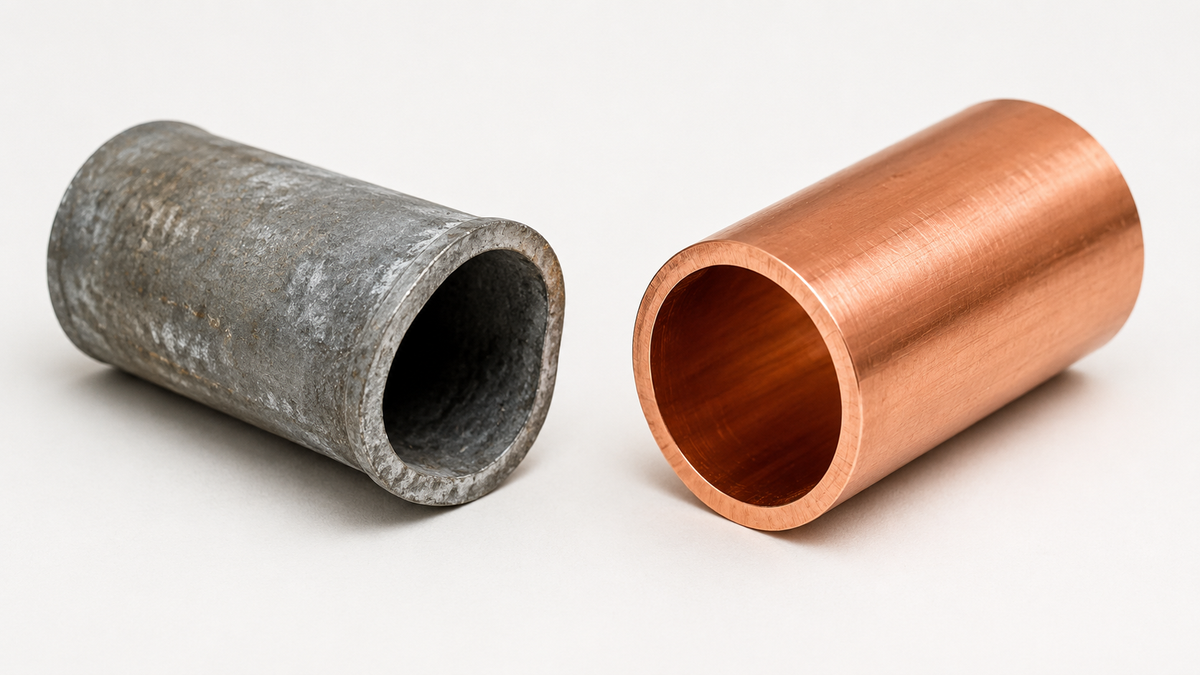
An unpainted lead pipe will normally:
- appear dull grey
- feel relatively soft
- sometimes have a swollen or rounded-looking joint near the stop tap
Copper is usually brown. Modern plastic supply pipe is often blue.
If you're still unsure, there is a simple test.
Wearing disposable gloves, gently scratch the surface of the suspect pipe with a coin.
Lead is soft. Scratching its dull grey surface should reveal shiny, silver-coloured metal underneath.
Avoid creating unnecessary dust and wash your hands afterwards.
If you aren't confident about identifying it ask a qualified plumber or your local water company.
My visible pipes are copper. Does that mean I'm clear?
Not necessarily. Someone may have replaced the internal plumbing with copper or plastic while leaving part of the original underground supply pipe in place.
So seeing copper underneath your kitchen sink is reassuring, but lead pipes can exist beneath the garden, driveway or pavement.
If you own a pre-1970 property and aren't sure whether the supply pipe was replaced, your water company can advise you.
You can also ask them to test the water at your kitchen tap if you suspect lead pipework.
What should you do if you discover lead pipes?
The DWI recommends letting water that has been standing in lead pipes run through before using it for drinking or cooking. This is more relevant first thing in the morning or after the house has been empty for several hours.
Running roughly a washing-up bowl's worth of water will normally clear standing water from a typical pipe, although longer supply pipes can require more.
You may notice the water suddenly become colder when fresh mains water reaches the tap.
This is not the long-term solution because if lead pipework is present, replacement is the preferred option.
Who is responsible for replacing lead water pipes?
This depends on where the pipe is.
There are effectively different sections between the water main and your kitchen tap.
The communication pipe runs from the water main in the street to the external stop valve near your property boundary. This belongs to the water company.
The supply pipe from the boundary into your home normally belongs to the property owner.
Internal plumbing is also generally the homeowner's responsibility.
If your water company finds that its communication pipe is lead and is at risk of contributing lead to your drinking water, the DWI says the company is legally required to replace its section.
Contact your own supplier before arranging work, as replacement programmes and procedures vary around the country.
Want to improve the water you actually drink?
Checking how your home is plumbed is the first step. If you find old lead pipework, replacing it should always be treated as the proper long-term solution rather than relying on filtration alone.

For drinking water at the kitchen sink, our System 40 Under-Sink Water Filter is designed to provide filtered water from a dedicated drinking-water tap. It is a simple option for households that want better-tasting water without changing the rest of the home's plumbing. These filters significantly reduce lead from the drinking water.
If you would rather filter water throughout the property, the BT65 Whole House Water Filter treats the incoming water supply before it reaches taps and showers around the home. It reduces lead, chlorine, sediment and a range of other unwanted substances while maintaining the high flow rates needed for a whole house.
Not sure which problem you actually have? Use our Find the Right System guide to compare the different types of water treatment and work out what makes sense for your home.
Can you drink water from the bathroom tap?
In a modern home where the bathroom cold tap is supplied directly from the mains, generally yes.
In an older property, find out whether the bathroom is supplied by a cold-water storage tank.
Tank-fed water isn't automatically unsafe. A correctly installed and well-maintained drinking-water tank can supply safe water. If you aren't sure, the mains-fed cold kitchen tap remains the sensible choice for drinking and preparing food.
And while you're looking at your plumbing, check what your incoming water pipe is made from.
Frequently asked questions
Is upstairs tap water safe to drink in the UK?
It can be. In many modern homes the upstairs cold taps are supplied directly from the mains. In some older properties they can be supplied from a cold-water storage tank instead. If you're unsure, check the plumbing or ask a qualified plumber.
Is bathroom tap water the same as kitchen tap water?
Not always. They may both be mains-fed in a modern plumbing system. In an older system, the kitchen cold tap could be mains-fed while the bathroom cold tap is supplied from a loft tank.
How do I know if my bathroom water comes from a tank?
Check whether there is a cold-water storage tank in your loft and find out which outlets it feeds. Lower pressure can also be a clue. The DWI suggests trying to stop the fully opened cold tap with your thumb. If you can completely stop the flow, it is more likely to be tank-fed.
Can you brush your teeth with bathroom tap water?
If the tap is directly mains-fed, it should be suitable for normal drinking-water uses. Where possible, the DWI recommends using mains-fed water for drinking, food preparation and cleaning teeth.
How do I know if my house has lead water pipes?
Homes built before 1970 are more likely to contain them. Check around your internal stop tap. Unpainted lead is normally dull grey, relatively soft and may have swollen-looking joints. Gently scratching it with a coin will reveal shiny silver metal underneath.
Can a house have copper pipes inside but lead pipes outside?
Yes. Internal plumbing may have been modernised while an older underground supply pipe remains. If you own an older house and aren't sure, contact your water company or a qualified plumber.
Can my water company test my water for lead?
Yes. If you suspect your home has lead pipework, the Drinking Water Inspectorate advises contacting your water company and asking about testing the water at your kitchen tap.
What should I do if I find a lead pipe?
Contact your water supplier and a qualified plumber. Running water that has been standing in the pipe before using it for drinking or cooking can reduce exposure in the short term, but replacing lead pipework is the long-term solution.


Leave a comment
This site is protected by hCaptcha and the hCaptcha Privacy Policy and Terms of Service apply.